It’s rare that a web product lasts 25 years, given how fast the industry cycles through technologies. But this month marks a quarter century of Drupal, the open source content management system (CMS). To mark the occasion, and also to discuss the launch of Drupal CMS 2.0 — which, confusingly, is not version 2 of the original Drupal — we spoke to founder Dries Buytaert.
“I think people think Drupal is this overnight success or something,” Buytaert tells The New Stack. “But I think in reality, it’s been this very slow, gradual growth.”
He notes that although he launched Drupal in 2001, the first Drupal conference wasn’t until four years later, in 2005 — “like, 30 or 40 people showed up,” Buytaert chuckles.
Drupal was launched on January 15, 2001 (coincidentally, the same day Wikipedia debuted). At the time it was a relatively simple PHP and MySQL content management system; indeed, its initial appeal was that it was far simpler than the bulky CMS software of the time, like Interwoven and Vignette. I can vouch for that, as I was using Interwoven in 2001 in my job as a company website manager — and I remember that it was a beast of a CMS.
Drupal complexity and its fit in the AI era
Ironically, Drupal itself became more complex over time, as it continued to expand and add to the core platform. Drupal these days is most often viewed as a DXP (Digital Experience Platform), competing with the likes of Adobe Experience Manager and Salesforce Marketing Cloud. “Drupal Core” is the name of the open source framework, and its tagline is “Create Ambitious Digital Experiences.”
Buytaert argues, though, that the complexity that Drupal has accumulated over the years has actually made it very suitable for the current AI era.
Complexity is “Drupal’s accidental advantage in AI” – Dries Buytaert, Drupal founder
“For a long time, I think Drupal was perceived as a little bit more complex, also more advanced to use,” he tells The New Stack. “And it turns out, I talk about it as Drupal’s accidental advantage in AI — like, we’ve built a lot of features that contribute to that complexity.”
His point is that AI systems (LLMs in particular) thrive on complexity — the more data that LLMs can gobble up, the better. Buytaert gives the example of “configuration versioning” in Drupal, which he says a lot of other CMSs don’t have. So if, for example, you move a block around on a page but then want to revert back, you can do that through configuration versioning.
“So those features, they actually make our APIs more complex, and sometimes our user interface more complex,” Buytaert says. “But it turns out these are exactly the features AI agents need […] because they make mistakes, right? Like, they hallucinate, they make mistakes. And so now we have the ability to undo or roll back those mistakes in a way that maybe most of our competitors don’t have.”
That’s a good way to spin the benefits of Drupal’s complexity, but the market reality is that the AI era has also forced Drupal to come up with simpler solutions.
Drupal CMS 2.0 and the push for non-developers
Up till very recently, the bulk of Drupal’s users have been developers — back in October 2022, Buytaert was telling The New Stack about Drupal’s “headless CMS” capabilities, which at the time was a trendy way for developers to set up a custom CMS for their organization or clients. But in a world where anyone can “vibe code” a website or web app out of seemingly thin air, Drupal needs to appeal to non-developers too.
This has resulted in a product called “Drupal CMS” — which is actually a completely separate product from the DXP software, although it’s still built on the foundation of Drupal Core.
Drupal CMS 2.0 is being released today, Friday. It comes about a year after version 1.0, which was released last January. Version 2.0 is both a return to the simpler Drupal CMS product of yore and a response to the current trend of vibe coding.
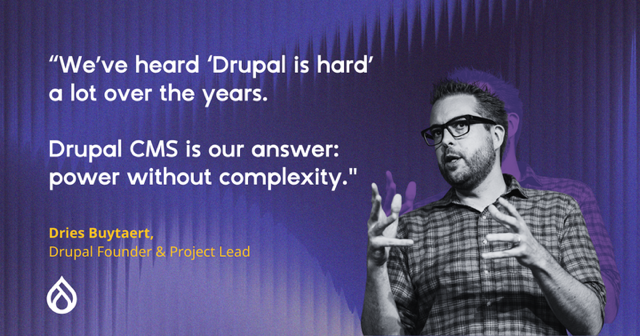
Dries Buytaert quote
“The idea is that we created a new version of Drupal, if you want to think about it that way, [although] it’s built on top of the old version of Drupal,” Buytaert tells TNS. “So it’s not a fork or anything, but it’s a new version of Drupal where we added a lot of capabilities with the idea to make Drupal easier to use for a broader audience of people.”
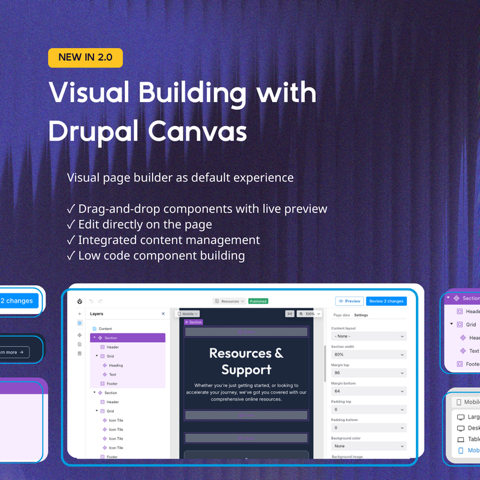
The main goal of Drupal CMS is to broaden its user base beyond developers, to include marketers and indeed all non-developers. To do this, Drupal CMS needed an easy-to-use visual interface for creating web pages — ideally one that included AI functionality, to help with layout and coding. With that need top of mind, one of the new features in 2.0 is Drupal Canvas, “a visual page-building interface” that comes with pre-built templates and “optional AI.”
Drupal Canvas; image via The Drupal Association
Interestingly, this return to simplicity and attendant embrace of AI has led to a boost in activity in the Drupal open source project, says Buytaert.
“It has really sparked a lot of energy in Drupal. […] If you look at the number of contributions in Drupal, especially to strategic initiatives, it has doubled in the last 18 months since the start of Star Shot [the original code name of Drupal CMS], and so it has really created this new energy, in a way. A lot of people have been contributing to it.”
Community takes 10 years to build
This brings us back to the core aspect of Drupal that has led to it continuing to grow and evolve over 25 years: Its open source community. Not only that, but a good portion of Drupal’s earliest adopters have stuck around.
“There’s a private email going around to [about] 50 of us that were around in the early years, and I would say half of them have moved on to do other things, and then the other half is surprisingly still involved through Drupal,” Buytaert tells The New Stack. “So there is definitely a core group that has been doing this for over 20 years, which is pretty special.”
“…everything worth doing, it’s probably best to commit for 10 years.” – Buytaert
What tips, then, does he have for new open source projects trying to get a foothold in a tech landscape dominated by multinational corporations like Google, Apple and Meta?
“Don’t expect overnight success,” Buytaert warns. “I think anything successful in life usually takes 10 years.”
He mentions not just the original Drupal project, but also the company he formed to sell Drupal products and services — Acquia, which he launched at the end of 2007 with his business partner, Jay Batson. After raising a lot of VC money, Acquia eventually sold to Vista Equity Partners for a reported $1 billion (Buytaert is still executive chairman at the company).
“It took, like, 10 years before CMOs and CIOs actually had heard about Acquia,” Buytaert tells TNS. “And so everything worth doing, it’s probably best to commit for 10 years.”
YOUTUBE.COM/THENEWSTACK
Tech moves fast, don’t miss an episode. Subscribe to our YouTube
channel to stream all our podcasts, interviews, demos, and more.