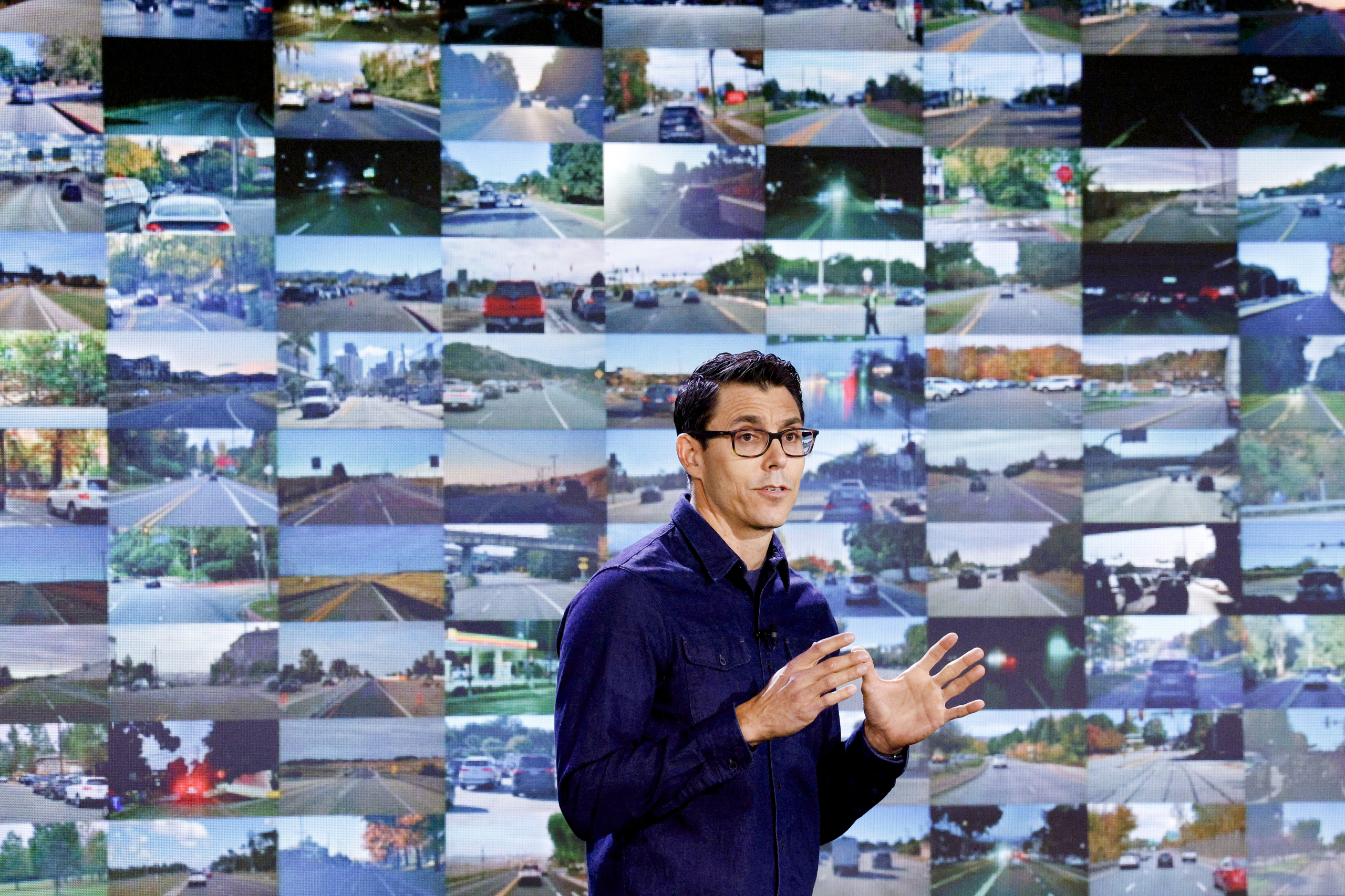
RJ Scaringe is sitting in Rivian’s Palo Alto offices, explaining why the adventure-themed EV company suddenly decided to build its own self-driving cars, when an unexpected guest glides by the window outside: Waymo.
Rivian’s AI pivot is about more than chasing Tesla
A robotaxi from the Alphabet-owned company pulls up outside the office. The passenger, an analyst from Goldman Sachs, briefly takes a selfie before climbing inside. The Rivian founder and CEO chuckles at the scene.
“That’s amazing,” he laughs. “So perfect.”
The arrival of the Waymo helps clarify the challenge that lies ahead for Rivian. A few hours earlier, Scaringe was onstage in front of an audience of hundreds of investors, reporters, and influencers gathered for the company’s announcement of a huge, expensive, and undeniably risky bet on autonomy and AI. The goal, he said, is for Rivian to design its own AI chips that can help power higher levels of autonomy, eventually leading to Level 4 — no human supervision required within certain limits. Could Rivian achieve what has taken Waymo decades to accomplish, but on a much shorter timeline?
More importantly, can it do it safer and more effectively than Tesla, the other EV-only company that is attempting its own messy transformation into an AI and robotics company? Rivian was founded as the outdoor lover’s answer to Elon Musk’s company: rugged, off-road worthy, and fully electric. Now it seems like it’s trying to chase the mercurial billionaire down an AI rabbit hole.
Scaringe insists this isn’t anything motivated by Tesla, but a recognition that the auto industry is staring up its own cliff. Advances in transformer-based encoding and large-parameter models prompted a fundamental shift in Rivian’s thinking of the “physical AI” of autonomous driving, he says. As such, Rivian began a clean-sheet redesign of its autonomy platform in early 2022. With the introduction of its Gen 2 platform, the company began building a “data flywheel” to train a large driving model (sort of like an LLM, but for driving) using real-world driving data from its fleet. And because the model is trained end-to-end, Rivian says that improvements in sensors or compute directly enhance its capabilities, allowing the system to continuously improve as hardware advances.
Either Rivian pursues its own self-produced, vertically integrated autonomy strategy, or it risks being left in the dust by Waymo, Tesla, and others. Several times during the presentation, Scaringe notes that this isn’t some bandwagon chasing, but rather a move born out of years of hard work and thoughtful design.
“I spent some time last night with the team talking about this right before we’re about to show it today,” Scaringe says onstage. “And one of the lead engineers looked at me and said, ‘Boy, we’ve been working on this for years, and I haven’t been able to talk about it. It’s so cool. Tomorrow I can start to talk about what I do every day, all day long.’”

Hands-free, eyes-off, and beyond
Rivian certainly isn’t shy about sharing details now. The company’s “AI and Autonomy Day” is set up like a Silicon Valley high school science fair. Tours take us throughout the Rivian office to see various projects: the new chip that will help power its AI ambitions, complete with microscopes to inspect the silicon in extreme close-up; its new in-car, AI-powered voice assistant that can navigate you to your favorite winery or pick the right song by Jelly Roll; and the lidar sensor that will help its vehicles drive themselves by creating a 3D picture of the world around it. There’s even an R2 wrapped to look like R2-D2 from Star Wars.
The most notable thing I get to experience is a test drive with an early preview of Rivian’s new hands-free point-to-point capability. A software update, released soon after the event, allows Rivian owners to operate “hands-free” on 3.5 million miles of road in the US and Canada. The point-to-point capability will come at a later date and will unlock even more partial autonomous driving. Think of it as Rivian’s answer to Tesla’s Full Self-Driving feature.
Rivian says that starting next year, if a road has clear, painted lane lines, drivers will be able to use hands-free driving. It’ll be part of a paid package called Autonomy Plus, offered either as a one-time purchase of $2,900 or a monthly $49.99 subscription. (By comparison, Tesla offers its premium FSD option for $8,000 upfront or a $99-per-month fee.) Rivian’s Autonomy Plus package will be available free to all customers until March 2026.
The most notable thing I get to experience is a test drive with an early preview of Rivian’s new hands-free point-to-point capability.
I get to experience about 45 minutes of this feature from the passenger seat of an R1S as it drives through a series of tricky scenarios around Palo Alto. A Rivian engineer sits in the driver’s seat, ready to take control if anything goes wrong, but he mostly keeps his hands in his lap and his feet off the pedals as the R1S navigates intersections, traffic signals, and a bevy of pedestrians, cyclists, and other vulnerable road users.
The car seems to handle itself just fine, with the engineer only once taking control of the vehicle to avoid getting stuck at a red light. At one point, we thread a narrow path between a passing truck on one side and a cyclist in a bike lane on the other — and while I think we come a little too close to the cyclist, the car didn’t slow down or wobble in the lane. Days after the event, I learn of other test rides with more disengagements than mine.
There’s none of the jerkiness or hesitancy that I typically associate with a first-gen driver-assist system. Maybe that’s because in addition to 11 cameras, the system is also receiving data from five radar sensors, helping it form a more complete view of the world around it. Tesla’s FSD system, by comparison, is camera-only.
With more cars equipped with partial automation hitting the road, safety researchers are growing increasingly worried about driver attention and the potential for these systems to cause crashes. But Rivian subscribes to the theory that drivers should work with the hands-free system by adjusting the steering or pushing the accelerator without disengaging it. Rivian can switch between two different types of steering controllers that allow the driver to input their own steering when they want, Nick Nguyen, director of product and programs for autonomy, tells me.
“We’re big believers in collaboration,” he says. “We want you to interact with it as much or as little as you want.”

The real test is still to come. Rivian’s Gen 3 system will include the company’s proprietary silicon chip and the same sensor stack as Gen 2, with one crucial addition: lidar. The laser sensor is not typically found in privately owned vehicles, featuring more prominently in robotaxis like Waymo. Rivian is planning to add it to the upcoming more affordable model, the R2 — and taking a huge risk in the process.
Lidar is pricey, but those costs are coming down. Rivian wouldn’t disclose its lidar supplier, but the difference between a camera-only system like Tesla’s and one with multiple sensors is stark. During the presentation, James Philbin, Rivian’s vice president for autonomy and AI, shows a side-by-side visual comparison of Rivian’s autonomy software identifying and interpreting objects ahead using only its cameras; cameras and radar; and the trifecta of cameras, radar, and lidar. The latter setup is the clear victor, spotting several hidden objects and even pedestrians that the camera-only or camera-plus-radar approaches could not.
In our interview, Scaringe clarifies that the R2 will begin production next year without lidar or the Gen 3 autonomy computer, both of which won’t be added until the end of 2026. On Reddit, Rivian fans are upset that the company couldn’t better time the rollout so that early adopters wouldn’t be left to choose between a less powerful R2 right away or a more powerful one later. But Scaringe insists that demand for R2 is already so high that Rivian doesn’t expect a significant sales impact.
What could impact sales is a janky, unreliable system. But Scaringe assures me that Gen 3 is anything but. The AI computer will feature a dual-chip setup capable of 1,600 trillion operations a second (TOPS), a figure that he claims would have been unimaginable a few years ago.
But what actually matters is how fast the computer processes information, like pixels for camera-based robotics. Rivian says its Gen 3 system will be able to process 5 billion pixels a second, which is not a common specification you hear tossed around in the AI world, but one Scaringe believes should impress people even more than the TOPS measure.
Scaringe insists that demand for R2 is already so high that Rivian doesn’t expect a significant sales impact.
“Tesla recently talked about theirs,” he says. “I’ll let you Google it, but it’s a lot less.” (It’s 1 million pixels per milisecond.)
The next major milestone is “eyes-off” driving, where users no longer need to watch the road and, according to Scaringe, can fully reclaim their time to read, use their phone, or relax. Beyond that lies personal Level 4 capability, where the vehicle operates entirely on its own on certain roads, no human supervision required.
Whether Rivian ultimately gets there will depend on whether the company can create trust around its products. And that will require a transparent approach to legal liability that most automakers, Rivian included, have yet to fully embrace.
Scaringe notes that as autonomy improves, human driving will shrink from roughly 80–90 percent of miles today to 10–20 percent within a few years, and eventually to zero. At that point, a driver’s personal skill level becomes irrelevant to risk assessment, and insurance must shift accordingly, he says. Rivian has a partnership with Nationwide for its insurance claims, but has yet to work out how it will accept liability for crashes that occur in its autonomous vehicles.
“This is like the ticky-tacky of the real work streams to make this all real,” Scaringe says. “Beyond the technology, but actually, like, the business systems that need to be designed.”

In Palo Alto, the reactions to Rivian’s announcements are enthusiastic. All the influencers and analysts I talk to are impressed with what they’re being shown. But despite this, the company’s stock falls 6 percent the day of the event to close at $16.43 per share. Tesla, meanwhile, continues to trade at over $460 per share. Rivian’s stock has since bounced back slightly, and while the company has eked out a gross profit in the past, it’s still facing a very tough road ahead with the elimination of the EV tax credit and the enormous capital costs that will be needed to realize its AI dreams.
And there’s still the issue of why Rivian is doing this in the first place. While fans may be left scratching their heads over why their favorite outdoor brand is chasing after Tesla with its AI strategy, the company is doing the necessary work to keep itself relevant in a new era, says mobility investor Reilly Brennan.
“Having an AI strategy is growing into a necessary component for public auto companies in this era — at least the ones that want public market comps on the high end of the continuum, a la Tesla,” Brennan tells me. “Consider it like those overachieving high school students trying to get into Harvard: It’s not a requirement that they both started a charity and play the contrabassoon, but it sure seems like everyone else who gets in is doing it.”
There’s peer pressure, and then there’s the necessity of finding new ways to earn money off your customers. A $50-a-month autonomy subscription could be a lucrative new revenue stream for Rivian, which needs to become profitable to survive.
Scaringe sounds like a true convert. He thinks that we’re rapidly approaching a time in which AI will become as accessible as “running water and electricity,” he says during the presentation. No mention is made of how much running water and electricity is consumed by AI, which, for a company that purports to care about the environment, could quickly become a problem.
And Rivian is not fully committed to following Musk’s ceaseless, clout-chasing pursuit of robotaxis and humanoid robots — though Scaringe admits that both remain a possibility. The company spun off its own robotics division as Mind Robotics earlier this year, after all.
“The part of the problem that’s not solved is the Level 4,” he tells me, standing up because he has several more interviews ahead, and my time is up. “And so that’s our focus, on the tech.”
Follow topics and authors from this story to see more like this in your personalized homepage feed and to receive email updates.
Source: www.theverge.com…