We’ve been reviewing some silly-priced gaming monitors in recent times but, some of the latest-and-greatest models wield premium features that are unnecessary for many buyers. Gigabyte’s GO27Q24A strives to keep things simple by stripping-away some of the less-universally popular, expensive technologies to produce a spartan gaming monitor that focuses on the category’s most-important facets, to keep the price down. Gigabyte has successfully done this before using WOLED and Tandem OLED panels in the same range, so how will this QD-OLED model fare?
Assembling the Gigabyte GO27Q24A is simple: the stem clips to the screen and the stand uses a single thumbscrew to attach to the stem without any tools being needed.
The stand is the same, solid, small-footprint unit that Gigabyte’s premium monitors use and it lets competitive types sit right up close to the screen. The stem is also the same seen on its superior siblings and affords a generous degree of manipulation to get the screen sitting just so: there’s -5°~+21° tilt, ±15° swivel and 90° pivot. There’s also 13 cm of height adjustment. Impressive.
Latest Videos FromPC Gamer
|
Screen size |
27-inch |
|
Resolution |
2560 x 1440 |
|
Brightness |
200 nits fullscreen, 400 nits peak HDR |
|
Response time |
0.03 ms |
|
Refresh rate |
240 Hz |
|
HDR |
DisplayHDR TrueBlack 500 |
|
Features |
Samsung QD-OLED panel, 2x HDMI 2.1, DisplayPort 1.4, 1x 3.5mm audio jack |
Buy if…
✅ You want an affordable, fast QD-OLED gaming monitor: It might not be the brightest, but this fast, colourful, 1,440p display doesn’t put a foot wrong when gaming.
Do not buy if…
❌ You want an all-purpose monitor for work, too: While the screen is usable for office tasks, its glossy finish is prone to reflections and text isn’t the sharpest.
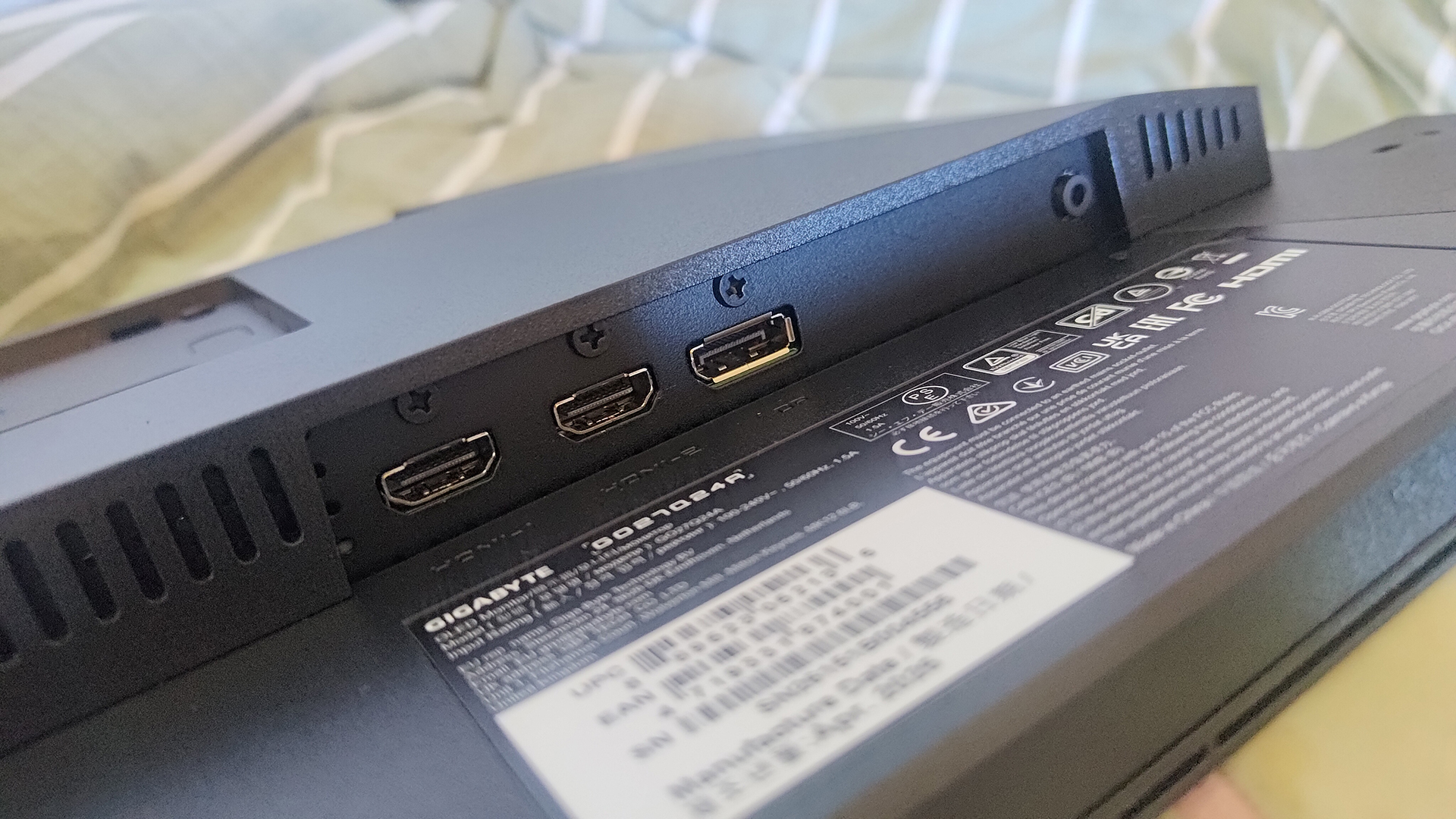
All that comes in the box is a cable-tidy clip that attaches to the stem, and a DisplayPort cable (I rather feel an HDMI cable would be more universally useful). Still, you don’t actually need many cables as there aren’t many places to stick ’em—there are just two HDMI 2.1 ports, a DisplayPort 1.4 port and a headphone jack. Forget your USB-C, KVM hub and optical ports. There’s also no RGB. We’re on a cost-saving mission, here.
Once up and running, you’re presented with a 27-inch, 1440p Windows Desktop that offers plenty of real-estate for work, but displays text that’s a smidge spidery for all-day office use in this day and age—people who often squint at spreadsheets would be better served elsewhere. But, this monitor isn’t for them.

(Image credit: Future)


People who often squint at spreadsheets would be better-served elsewhere. But, this monitor isn’t for them.
It’s a Samsung QD-OLED panel (likely Gen 3) which has the usual, impressive-sounding 0.03ms pixel response time and 1:1,500,000 contrast ratio. It also displays 99 percent of the tricky DCI-P3 colour space (so pernickety designer-types will warm to its colour accuracy). However, despite its support for HDR10, the (understated) standout spec is its peak fullscreen brightness of just 200 nits. In a market where everyone (not least Gigabyte) is yelling about their 1,000+ nit brightness, that’s unusually very low (for a QD-OLED panel especially) and likely related to where many of the production costs have been reduced. But, how does it actually perform when gaming?

If you don’t regularly look at super-premium gaming monitors, you could well be wondering where the limitations are. Contrast is excellent, colours are vibrant and, in HDR mode, both colourful and monochromatic transitions and gradients are smooth and step-free. The lack of peak brightness means HDR can be kept active all the time without melting your eyes. It generally does a good job of displaying bright and dark areas of content simultaneously and details still get revealed in darker areas (making it hard for enemies to jump out of shadows) but details can get lost in brighter highlights (not unlike many premium monitors, frankly).

Gigabyte veneers the screen with a semi-gloss, anti-reflective coating which, in some scenarios, does a physics-defeating job at eliminating reflections. However, when viewing dark content, or when you’re in a bright environment, it can still transform into a black mirror.
Nvidia G-Sync and AMD FreeSync Premium technologies are present to help prevent image tearing, and VRR is present to stop brightness flickering. Gigabyte’s also states that its Ultra Clear motion-smoothness technology (black-frame insertion) will be present in a future firmware update, but we’ve heard that one before.
The GO27Q24A also has a fast (0.03 ms stated grey-to-grey) pixel response time and this marries with a 240 Hz refresh rate to keep very-fast-moving objects looking smooth, crisp and clear to the point where only elite-level eSports players might grumble.

Ultimately, it functions very well as a gaming monitor. The HDR peak brightness of 400 nits means the in-your-face, potentially eye-piercing impact of premium models is missing and technical, true-black performance is only very good rather than outstanding (a black screen can feel slightly washed out), but most gamers will care more about the excellent colour vibrancy, contrast and speed on offer.

(Image credit: Future)


Gigabyte packs in most of its premium gaming enhancements too. They’re activated by a joystick button at the rear (on the right) of the screen. Their degrees of usefulness will depend on the proclivities of each user and most detrimentally affect overall image quality in some way.
The AI Black Equalizer destroys contrast (to selectable degrees) by brightening dark areas to prevent enemies hiding in very dark shadows. Super Resolution enhances details in areas of uniform colour to make objects look bad but harder to miss.
Night Vision turns the screen green for those who like to LARP as a Navy SEAL super soldier.
Game Info features include adding an on-screen timer that counts up or down. You can add on-screen crosshairs of various designs and offset them from the middle of the screen if necessary. These can be useful when playing CoD in Hardcore mode. Also, unlike (for example) MSI, the crosshair won’t move around the screen every time you move the joystick button.
Night Vision turns the screen green for those who like to LARP as a Navy SEAL super soldier. Flash Dimming helps prevent flashbangs acting like in real-life, while Eagle Eye magnifies the middle of the screen like a sniper scope. I’ve found the latter to be unusably poor in past iterations, but the new implementation (which features a round-shaped ‘optic) feels increasingly like an unfair advantage. Still, it’s still some way off being a hacker tool.

(Image credit: Future)


Many of these settings can be activated using Gigabyte’s ‘Tactical Switch’ which sits just below the joystick button. However, the primary function of this is to transform the screen into a more competitive FPS-display. Using the menu, you can change the settings with one press to: 1920 x 1080 (16:9); 1280 x 960 (4:3); 1024 x 768 (4:3); or 1280 x 1024 (5:4) while (potentially) dropping the display-size down to 24 inches. This suits competitive eSports players who sit close to the monitor, want low resolutions for easier headshots and who don’t want to be distracted in their peripheral vision. Clicking the button simply acts like you’ve added a different screen (from Windows’ perspective). It works very well. Unlike other Gigabyte gaming monitors, it doesn’t increase the refresh rate, though.

Another feature that can be activated by the Tactical Switch is pixel cleaning which is part of the OSD’s OLED Care technology. This can automatically (or manually) scan the pixels of your screen and eliminate any dark or bright spots that develop over time. It can also detect static images and logos by arousing the relevant pixels to help prevent burn-in. It works in tandem with Gigabyte’s bespoke, fan-less cooling technology (which uses optimised heat flow channelling, a bespoke heatsink and a graphene film layer) to enhance longevity and back Gigabyte’s three-year warranty that includes burn-in.

At the end of the day, the Gigabyte GO27Q24A doesn’t put a foot wrong. Yes, there are brighter models out there and they might have features like KVM switches and even-faster refresh rates, but these are unnecessary and expensive embellishments to many gamers. The GO27Q24A’s RRP of $450 is low compared to many rivals (and Gigabyte siblings). It even launched at $299 via Newegg for its first month on sale, and we wouldn’t be surprised to see good deals on this again. Frankly, even at $450 it’s a bit of a bargain, but it’s hard to look past the excellent Alienware AW2726DM, a monitor that uses the same panel but despite being an Alienware it comes in cheaper.
Best gaming monitors 2026