
The video game industry is in turmoil. Microsoft and Sony are starting to pivot to their next consoles, but it’s not looking great: Prices are soaring, Sony is killing the video game disc, and Microsoft is jettisoning studios ahead of the transition. What could entice people to pay?
The PS6 sure sounds like a handheld
On the Xbox front, we genuinely can’t say. But on June 5th, Sony dropped an unusual number of hints about the future of PlayStation in an investor “business meeting” Q&A.
This Q&A arrived a month before Sony announced the end of PlayStation discs. But when I reread it with the death of discs in mind… it hits differently. Let’s walk through it, shall we?
Page two is where Sony Interactive Entertainment CEO Hideaki Nishino drops the first hints (all bolding mine):
In developing the next-generation platform, we aim to anticipate changes in how players play and their evolving needs, while making the PlayStation ecosystem more accessible and approachable to a broader range of players.
Those words might seem trite and meaningless by themselves. Isn’t it every company’s responsibility to skate to where the puck is going to be? But Sony has a specific idea where that puck is headed.
The top of page three begins with an investor question about the price of a next-gen PlayStation. But instead of talking about price right away, Sony intriguingly hijacks the question:
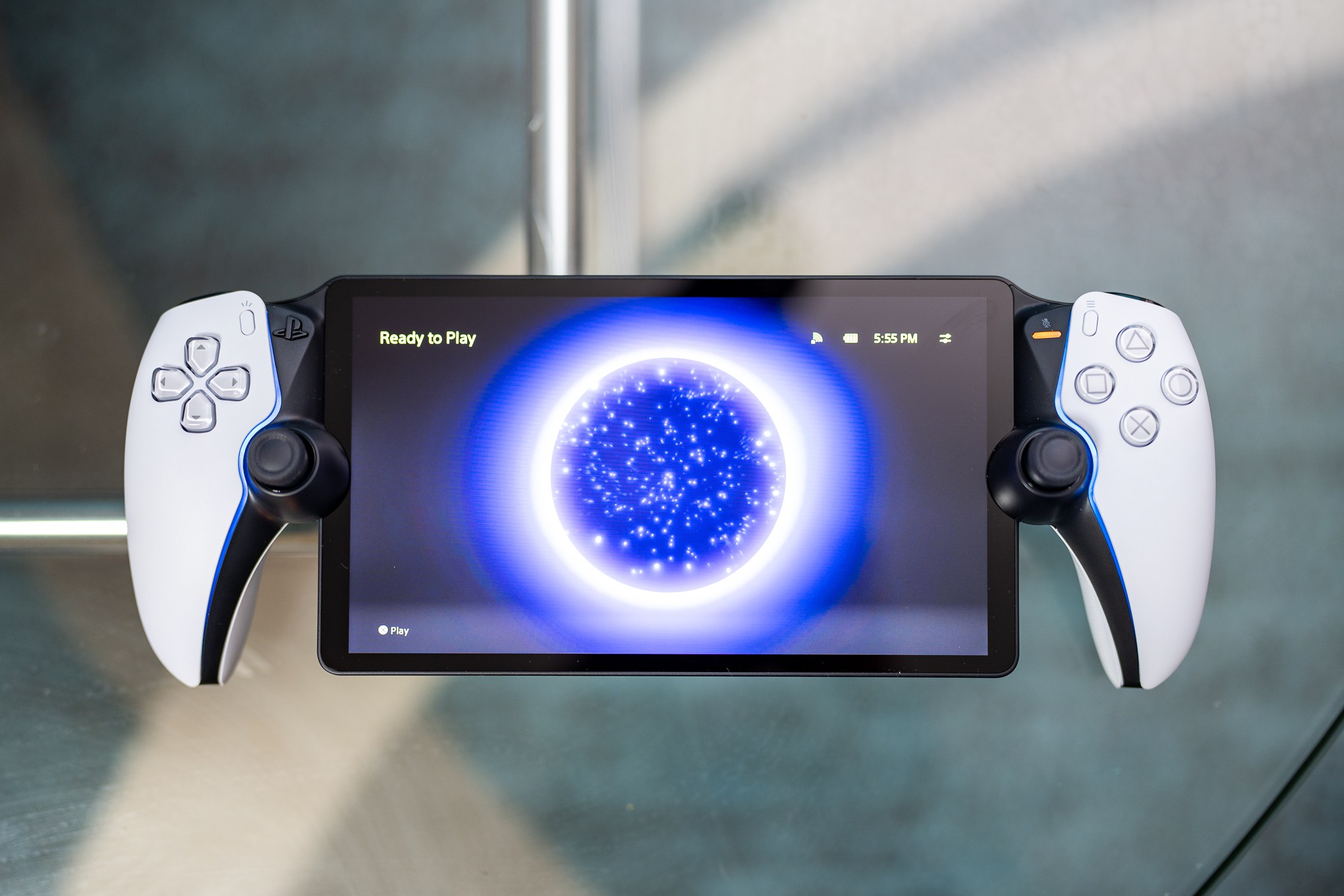
First, we regard hardware as the base for providing the gaming experience, and by offering products such as the PlayStation Portal Remote Player (PS Portal), we aim to provide experiences tailored to users’ play styles beyond the living room, which has traditionally been considered the primary usage environment.
First, Sony said the next PlayStation will try to anticipate changes in how users play. Now, Sony’s saying those changes may be about gaming outside the living room, that the living room might no longer be the “primary usage environment” in future, and it uses a handheld as the example.
Later, on page five, Sony partly hijacks another question to set the same “beyond the living room” agenda. Asked “How can you bring back to the PlayStation platform users who migrated to gaming PCs during the COVID period,” Sony says that “PlayStation has long been strongly associated with the idea of playing in the living room,” that Sony wants “to break away from the fixed perception that ‘PlayStation equals the living room,’” and that Sony wants “a seamless experience that can be enjoyed naturally beyond the living room.”
Sony also turns the question about PCs on its head: “For the next-generation platform, rather than simply serving as an alternative to PCs, we aim to deliver value that is unique to PlayStation.”
What kind of PlayStation is outside of the living room that isn’t just an alternative to PCs? A handheld, I would think.
Another possible answer is cloud gaming, but Sony throws cold water on the idea that you’ll just be streaming PlayStation games to a phone or PC — it seems a dedicated handheld is the ticket there, too. Asked about cloud gaming, Sony says:
- “[W]e designed PS Portal as a dedicated device to reliably deliver the PlayStation gaming experience, which is predicated on controller-based gameplay and a large screen.”
- “Because it is difficult to provide a sufficiently high-quality experience through smartphone touch controls or a PC’s keyboard and mouse, our cloud strategy is not to rapidly expand to smartphones and PCs, but rather to focus on environments where quality can be assured.”
- “Cloud streaming also requires minimal memory, making it an increasingly attractive low-cost thin client device in the current market environment where memory prices are rising.”
So when Sony’s talking about its “true digital platform” in places “beyond the living room,” it doesn’t sound like it’s talking about turning every screen into a PlayStation — it’s not pulling an “Xbox everywhere” with cloud gaming. Sony wants PlayStation controls in your hand, and the “increasingly attractive low-cost thin client device” comment makes it sound like Sony will keep making PlayStation Portal handhelds with those controls built in.
But the PlayStation Portal arguably doesn’t have a “large screen,” and it can’t dock to a TV like a Nintendo Switch to gain one. Might a future Sony handheld change that?
Sony does address pricing after its first “beyond the living room” hints, warning us that the next PlayStation won’t be cheap:
As for pricing, it is not realistic for us to absorb all component cost increases, and we have already implemented some price increases outside Japan. At present, however, sales are proceeding as planned, and we do not believe this has led to a decline in customer demand. As a principle, we do not intend to sell hardware at significant losses. At the same time, we are carefully monitoring the market and continuing to evaluate our approach. We believe it is important for us to make every effort to ensure that customers fully understand the value we provide in relation to pricing.
The following question is where Sony sees PlayStation in 10 years. “[W]ill it remain a hardware gatekeeper reliant on console economics and profit from software, or transition toward an IP-led content platform with hardware as just one distribution channel?”
In other words: Is Sony sticking with the razor-and-blades model where it sells you a box so it can actually sell you games, or does it just want to sell the games?
There’s a bunch to unpack in Sony’s reply:
The value of our proprietary device lies in the experience, not the hardware itself. As a dedicated gaming device, it provides seamless, immediate access to content—unlike general-purpose devices, which involve multiple layers before gameplay. We aim to expand reach across diverse play styles and environments while maintaining confidence in our first-party software. At the same time, most of the value of our ecosystem is driven by third-party publishers, who benefit from our large install base, strong community engagement, and monetization tools. This supports a shift toward a true digital platform business. While opportunities exist beyond console (e.g., mobile and PC), we aim to proceed carefully, ensuring we are not constrained by our own hardware ecosystem. Overall, we see expansion potential over the next five years.
IP is a crucial point of differentiation for our first-party content, and it is part of the virtuous cycle that is the PlayStation experience. We try to create benchmarks, quality bars and inspirational content. Even though first-party software is a minority of the overall sales of SIE, it serves as a core reason why people enter the PlayStation experience. Our valuable IP franchises are important in increasing brand loyalty.
We are assessing multiple scenarios and options, including technology, hardware and business models. We are focused on how to optimize profitability in the future.
When I first scanned this in June, I thought Sony was hedging bets about whether it’ll truly keep games exclusive to PlayStation instead of putting them on PCs too. I was fixated on the “ensuring we are not constrained by our own hardware ecosystem” bit.
But now that discs are no longer part of PlayStation’s future, Sony’s “true digital platform business” and profit-led agenda hit different. Sony will have a “true digital” business because it’s not physical; it can profit off every sale because they’ll all go through the digital PlayStation Store, with no disc-slinging retailers or secondhand markets taking a piece of the action.
I find the question at the bottom of page 6 particularly intriguing, because whoever asked it seems to think “changes” are coming with PlayStation 6. Did they know Sony was killing off discs before Sony made that official? Take a peek:
Q: If you introduce changes in the gaming experience on the next-generation platform, do you expect those changes to translate into revenue growth?
A: While the overall revenue structure itself is not expected to change significantly, backward compatibility and digitization have clearly expanded the reach of content. One notable example is that when a new PS5 title is released, users can easily revisit and play past PS4 titles from the same IP, making it easier for them to access a wide range of content.
Either way, it sounds like Sony is suggesting the next PlayStation will still be backward-compatible with PS4 and PS5 games, though it’s not yet clear whether Sony has a disc-to-digital solution like Microsoft or if it will make you rebuy content. Backward compatibility is to be expected now that every console is basically a PC, but it’s still nice to hear.
Lastly, the Q&A does seem to cement the reports that Sony is mostly done releasing its tentpole single-player PlayStation exclusives on PC. While Sony says that “Creators may push to expand titles to other platforms such as PC to maximize reach,” it clarifies later that “In some areas, such as live service games, broader platform expansion can make sense.”
Here’s what I think: Sony is making a handheld PS6, as has been reported for some time, but it’s no longer a side dish — it might even be the main course. The Nintendo Switch and Switch 2, respectively the company’s best-selling and fastest-selling game consoles, have cemented that a do-it-all console-handheld hybrid is the most popular and profitable kind of console yet.
Sony will still make a beefy box for the living room to compete with Xbox and PCs, but the price may be so outlandish amid RAMageddon that traditional console buyers won’t be able to justify the spend. It’ll be the unnecessary but nice-to-have “PS6 Pro,” perhaps. While the handheld won’t be cheap, either, it’ll be the only way to play Sony’s big single-player games on the go — Sony will no longer let gamers think they can buy a PC handheld to play PlayStation exclusives.
Once it produces that handheld, Sony will arguably have made its first system where discs no longer make sense. Rumor is the PlayStation handheld should play full-fat PS5 games, but you’re obviously not going to stick Blu-rays into a handheld. Would you really want Sony to create another proprietary mini-disc format like it did for the PSP?
It’s not like Sony needs a wall of discs at your local Best Buy or GameStop to get its money’s worth out of that handheld, either. Those who buy Sony’s handheld will experience the Steam Deck effect of suddenly having the ability to play the latest games anytime, anywhere, and wanting all their games to be that way — but when they go to buy more, they’ll only be able to buy brand-new digital titles from Sony.
We’re losing something valuable when we lose video game discs. But I doubt Sony’s planners see it that way.
Follow topics and authors from this story to see more like this in your personalized homepage feed and to receive email updates.
Source: www.theverge.com…